Meta Andromeda is the part of Meta's ad system that picks which ads to even consider for each person. It makes that choice by reading your creative.
For a Shopify brand, this changes the job. Targeting matters much less than it used to, and the creative now finds your audience. You give Meta broad targeting, and Andromeda decides who sees each ad, based on what the ad shows and who tends to respond to it. So you spend less time picking audiences and more time making different creative and checking which of it brings new customers.
This guide covers what Andromeda is and what changed for a $500K to $5M Shopify brand. It then gives five changes to make and the mistakes to avoid. One example runs through it: a skincare brand running two creatives in one broad campaign. The numbers are illustrative but realistic, so you can follow the logic and use your own.
What Is Meta Andromeda?
Meta serves an ad in three steps. First, retrieval takes the tens of millions of ads that could run in a slot and narrows them to a few thousand worth a closer look. Then ranking scores that shortlist for the person and the placement. Then an auction picks the one ad that gets shown.
Andromeda is the retrieval step. Meta rebuilt it in late 2024 and rolled it out through 2025. Meta's own engineering write-up reports a 6% recall gain and an 8% ad-quality gain on selected segments. It also says retrieval handles about a thousand times more ads than the later stages.
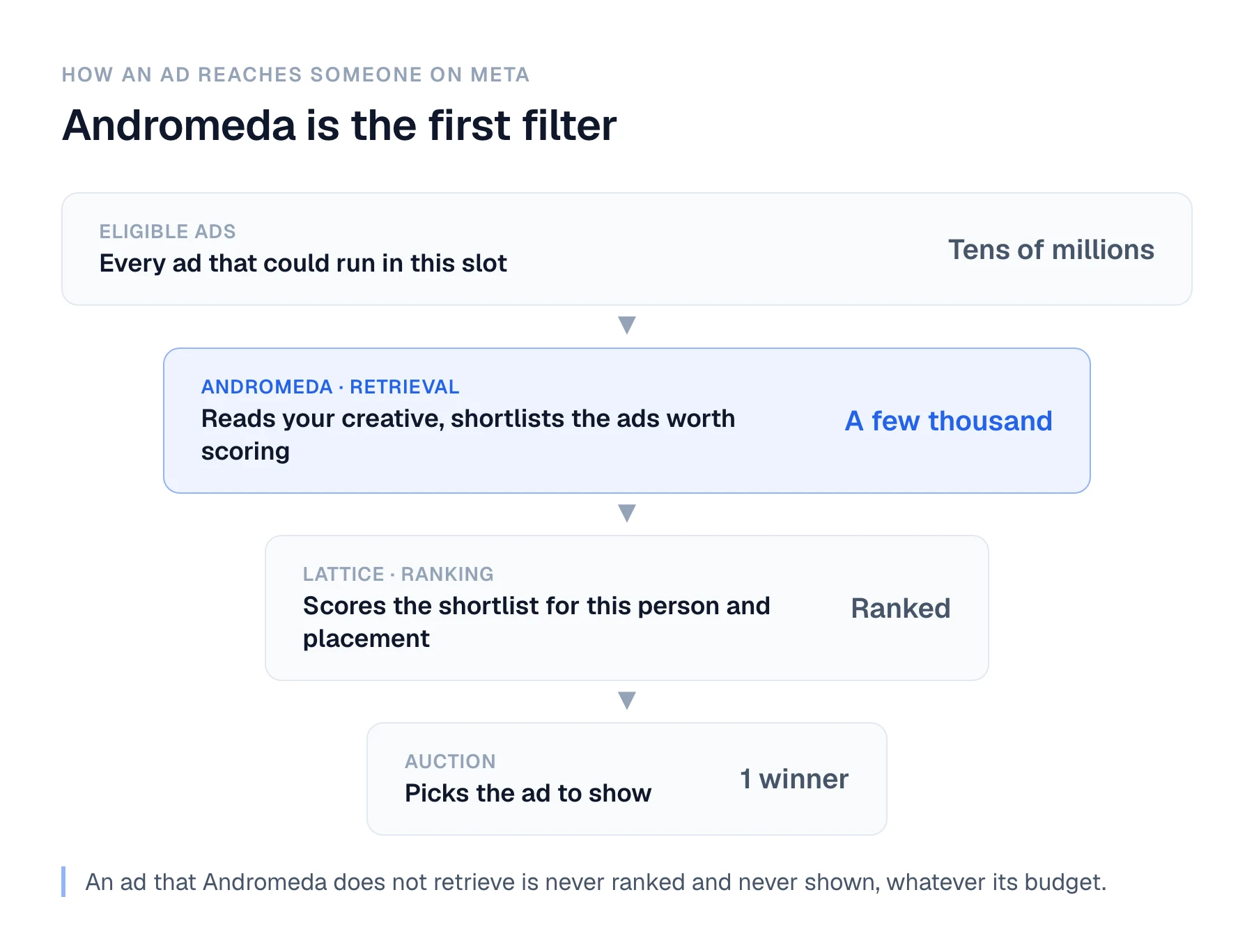
Retrieval decides whether your ad gets a chance at all. An ad that Andromeda does not retrieve is never ranked and never shown, no matter how much budget sits behind it. So the first job of your creative is to get retrieved for the right people.
Two newer systems sit next to Andromeda, and you will see all three names in 2026 coverage. Here is what each one does.
| System | Stage | What it does |
|---|---|---|
| Andromeda | Retrieval | Reads your creative and shortlists a few thousand ads from the eligible pool. |
| Lattice | Ranking | Scores that shortlist for each person and placement. |
| GEM | Training | A larger model that trains the ranking models. Meta says it lifted conversions about 5% on Instagram and 3% on Facebook Feed. |
GEM stands for Generative Ads Recommendation Model. You do not manage any of these yourself. They run under the campaign types you already use, and Advantage+ Shopping is the format built to lean on them fully.
What Andromeda Changed for Shopify Brands
The old system started from the audience you chose. You picked interests, lookalikes and custom lists, and Meta showed your ad to those people.
Andromeda starts from the ad instead. It reads the visuals, the copy and the format, then finds people who behave like they would respond. Your creative is now the main way you tell Meta who to look for.
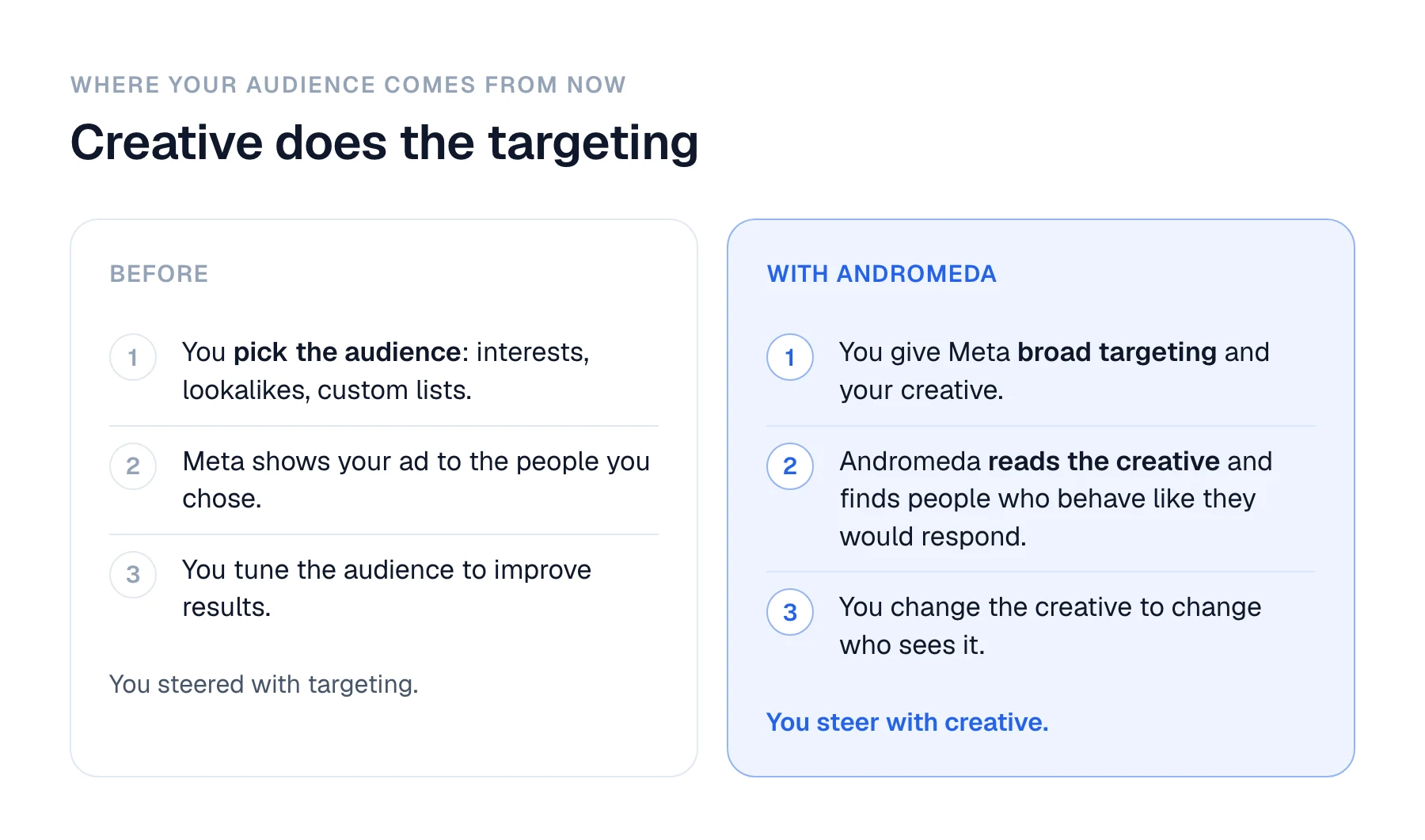
Three things follow from that shift. Broad targeting usually beats narrow targeting now, because narrow audiences fight a system that wants to find responders on its own. Creative variety does more work than audience tweaks, because the system needs different ads to reach different kinds of buyers.
The return on ad spend (ROAS) number in Ads Manager is also harder to trust. Broad delivery reaches people who already know you, and more conversions are estimated or counted from views rather than clicks. That last point is where most of the money leaks, and the measurement step below deals with it.
How to Adapt Your Meta Ads to Andromeda
None of this needs a new tool or a rebuild. These are five changes to how you set up the account, make creative, and read results. They are listed in the order we would make them.
1. Consolidate Your Account Structure
Andromeda works best with fewer, broader campaigns. Each one needs enough budget and data to learn.
A good structure for a brand this size has three parts. Run one or two broad Advantage+ Shopping campaigns for prospecting. Run one manual retargeting campaign for cart and checkout abandoners. Keep the total down to a handful of active ad sets.
Splitting the same budget across fifteen narrow ad sets gives each one too little data, so none of them leave the learning phase.
2. Use Distinct Creative Concepts
Variety here means different ideas, not different button colors. Meta groups near-identical ads together. Twenty recolors of one ad act like a single concept fighting itself, while five different concepts can each win with a different kind of buyer.
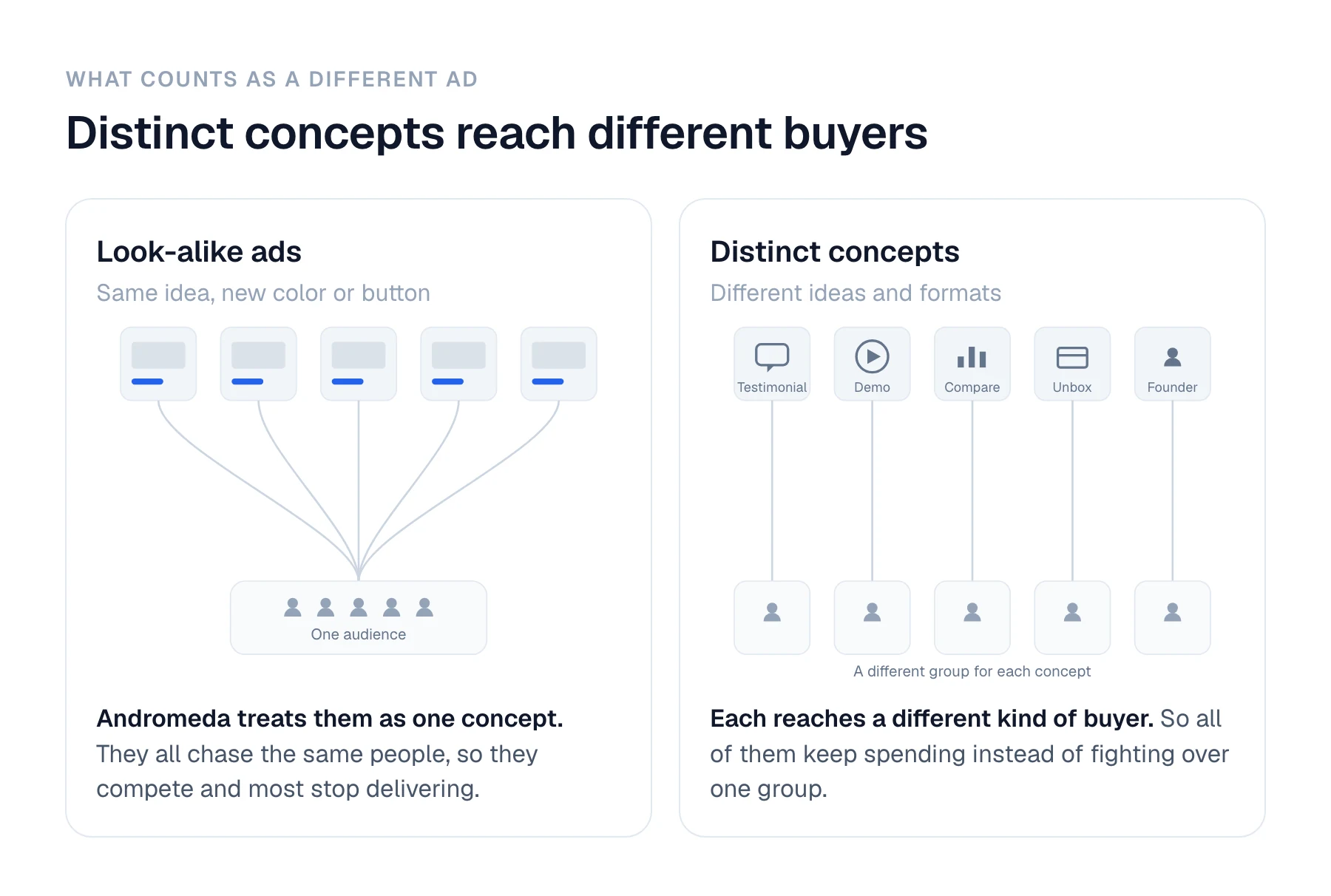
Aim for a few distinct concepts in rotation, each with a small number of variants. A testimonial, a problem-and-demo video, a comparison, an unboxing and a founder story are five concepts. Five crops of the same testimonial count as one.
3. Match Creative Volume to Your Budget
More creative is not automatically better, whatever some creative tools claim. The advice to upload twenty or more creatives per ad set comes from accounts with big budgets. Each asset there gets enough spend to gather data, and most Shopify brands at this size do not have that. When you have more creative than budget, learning slows and delivery splits across too many ads, so none of them get a fair read.
Give each concept enough daily budget to reach about fifty purchases before you judge it. Run fewer concepts if your budget cannot support more. Upper-funnel prospecting can hold more concepts than lower-funnel campaigns, where a tighter set works better.
4. Send Clean Conversion Signals
Andromeda and the ranking models learn from the conversions you report back. If those events are missing, late or double-counted, the system learns the wrong lesson about which creative and which people are worth finding.
This is a tracking job, not a reporting one, so the fix lives in your pixel and Conversions API setup. Check three things: that purchases fire once, that the pixel and server events are deduplicated, and that your catalog is connected.
Daymark does not send conversions to Meta and cannot fix this for you. Clean signals are the single biggest input you control, and no amount of creative makes up for broken ones.
5. Judge Creative on New-Customer CAC
This step protects your margin. You can no longer steer who sees each ad, so the only reliable test is whether a creative brought new customers at a profitable cost. The ROAS in Ads Manager does not show that. Broad delivery finds people who already buy from you, and a creative can post a high ROAS just by reselling to them.
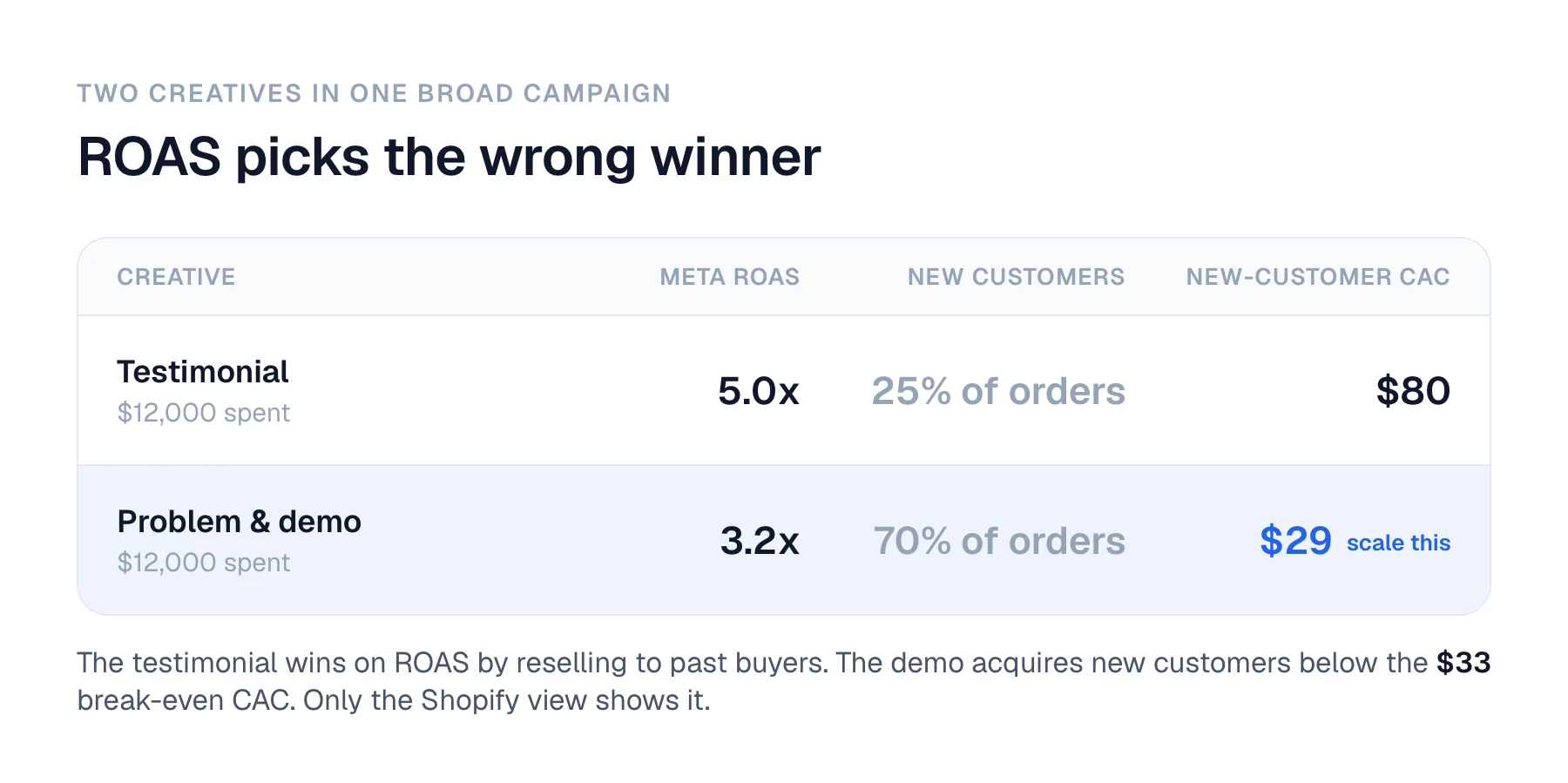
Take the skincare brand. Both creatives spent $12,000 in the same broad campaign.
The testimonial reported a 5.0x ROAS, which looks like the winner. But only a quarter of its orders came from new customers, so its new-customer cost of acquisition (CAC) was about $80. The problem-and-demo video reported a lower 3.2x ROAS, yet 70% of its orders were new customers, so its new-customer CAC was about $29.
On a $60 order at a 55% margin, the brand can spend about $33 to get a customer and still break even on the first order. So the demo is the creative to scale, and the ROAS column points at the wrong one.
Our guide to calculating your real CAC from Shopify shows how to pull the new-customer count. A separate guide on why Meta and Google revenue rarely matches Shopify covers why the platform number runs high.
This is the measurement gap Daymark is built for, and it stops at measurement. Daymark reads your Shopify orders next to your Meta and Google spend. It answers questions like "Is Meta bringing better customers than Google?" and "Why did CPA go up last week?", using new versus returning customers and blended profit rather than the platform's own ROAS.
After you move budget to the demo concept, it shows whether Meta's new-customer CAC and blended profit actually improved. That way you react to your bank account, not to Ads Manager. Read more about comparing ad spend with the customers it actually brought.
Common Meta Andromeda Mistakes to Avoid
Most of the damage comes from old habits. Running too many narrow ad sets starves each one of data. Shipping near-identical variants gives Andromeda nothing new to place. Cutting an ad after three days judges it before it has learned.
Real creative fatigue usually takes one to two weeks to show up, and a day-three collapse is more often a delivery change than fatigue. Our post on the signs of Meta ad fatigue covers how to tell the two apart.
Two more mistakes are common. The first is trusting Ads Manager ROAS as profit, which the example above takes apart. The second is expecting Andromeda to explain itself. It optimizes delivery, but it does not tell you why a creative worked, so you still need your own read on what to make next.
When Advantage+ Shopping Works Best
Broad Advantage+ campaigns need enough material and data. Below certain levels, they do worse than a manual setup.
Operators tend to cite a few readiness signals: a catalog of at least 30 products, at least 15 live creatives, and about 50 purchase events a week with clean Conversions API tracking. These are directional numbers from practitioners, not official Meta thresholds, so treat them as a rough check rather than a rule.
If you are below them, a simpler manual setup with tight audiences can be the better choice for now. Use that time to build up your creative and conversion volume.
What to Do This Week
Consolidate into one or two broad prospecting campaigns, and put three to five different concepts into rotation. Confirm your purchase events fire once and are deduplicated across the pixel and Conversions API. Then judge each concept on new-customer CAC against your break-even number, not on the ROAS in Ads Manager.
If you want the profit side read for you, Daymark connects your Shopify, Meta and Google data. It shows whether your broad campaigns are acquiring new customers at a cost you can afford. See how it works on our page about comparing ad spend with real Shopify results. Or start a 14-day free trial and check your own Meta spend before your next budget decision.
Frequently Asked Questions
What is Meta Andromeda?
Meta Andromeda is the retrieval stage of Meta's ad system, which Meta rebuilt in late 2024. For each ad slot it narrows tens of millions of eligible ads down to a few thousand worth ranking, and it does that by reading your creative. An ad it does not retrieve is never ranked, never enters the auction, and never gets shown, whatever its budget.
Is Andromeda the same as Advantage+?
No. Andromeda is the retrieval technology that runs underneath all Meta campaign types. Advantage+ is a set of automated campaign formats, and Advantage+ Shopping is the one built to use Andromeda most fully. You turn on Advantage+ campaigns in Ads Manager, while Andromeda works in the background and is not something you switch on or configure yourself.
Does audience targeting still matter under Andromeda?
Much less than it used to for prospecting. Andromeda reads your creative and finds people likely to respond, so broad targeting usually beats narrow audiences, and your creative does most of the audience-finding. Targeting still matters for retargeting, where you deliberately reach cart and checkout abandoners, and for exclusions that keep you from paying to reach existing customers.
How many creatives do I need for Andromeda?
Fewer genuinely different concepts beat a large pile of look-alikes. Aim for three to five distinct ideas in rotation, each with a few variants, rather than twenty recolors of one ad. Match the number to your budget, because each concept needs enough spend to reach roughly 50 purchases before you can judge it. Splitting a small budget across too many ads means none of them learn.
Why does my Meta ROAS look good but profit stay flat?
Broad delivery under Andromeda reaches people who already buy from you, so a creative can post a high ROAS by reselling to past customers rather than acquiring new ones. The platform number also counts view-through and estimated conversions, which runs it higher than your bank account. Judge each creative on new-customer cost of acquisition from Shopify against your break-even, not on Ads Manager ROAS.
Is a day-three drop in an ad creative fatigue?
Usually not. Real creative fatigue takes about one to two weeks to show up, as frequency rises and click-through rate slips. An ad that collapses on day three is more often a delivery change, where Andromeda shifted who sees it, than worn-out creative. Swapping the creative will not fix a delivery change, so check frequency and audience overlap before you blame the ad.
About the author

Co-Founder, Daymark
Karan is a co-founder of Daymark, where he builds the connections between Shopify, ad platforms, and warehouses that turn scattered store data into one source of profit truth. He writes about Shopify analytics, data integration, and using AI to query store data without SQL.
LinkedIn