Nov 9, 2025 · 17 min read
ETL vs ELT - Differences
First-hand guidance from the Daymark team on analytics workflows, growth reporting, and the operational metrics teams use to make decisions.
Data integration is critical in modern analytics, and two common approaches are ETL and ELT. Both involve moving data from source systems to a target data store, but the sequence of operations differs.
ETL (Extract, Transform, Load) performs data transformations before loading into the target system, while ELT (Extract, Load, Transform) loads the raw data first and then transforms it within the target system.
As organizations deal with ever-growing volumes and varieties of data, choosing the right approach (or combination of approaches) is essential to meet their analytics and compliance needs.
In this post, we’ll explain what ETL and ELT mean, how they work, their key differences, and when to use each method.
What is ETL?
ETL stands for Extract, Transform, Load, a traditional methodology for integrating and preparing data. In an ETL pipeline, data is first extracted from various sources, then transformed on a separate processing server or staging area (to cleanse and structure the data), and finally loaded into a target database or data warehouse.
This process ensures that by the time data reaches the warehouse, it is already conformed to the required schema and quality standards.
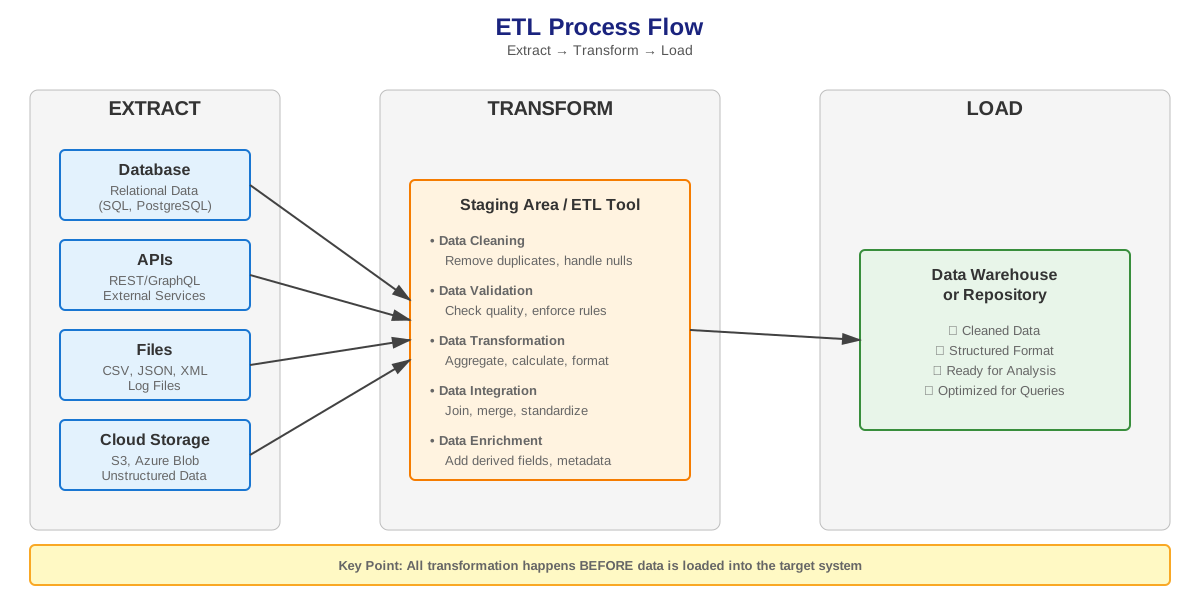
The ETL approach emerged in the 1970s and became widespread alongside the rise of relational data warehouses in the 1980s. It remains popular for on-premises and legacy systems with limited storage or processing power.
A real-world example of ETL is loading data into a traditional OLAP data warehouse: such warehouses often only accept relational (SQL-based) data, so ETL is used to convert and conform incoming data to the warehouse's schema before loading.
Because ETL performs a strict transformation step upfront, it ensures high data quality and can strip out or mask sensitive information as needed before the data reaches the warehouse. This makes ETL well-suited for industries with heavy compliance requirements – for instance, personally identifiable information (PII) can be removed or encrypted during transformation to meet privacy regulations.
How ETL works: The ETL process can be broken into three key steps:
- Extract: Data is collected from one or more source systems (which might include databases, files, or applications). The extracted data might be in various formats or structures.
- Transform: The data is then processed in a dedicated ETL server or staging area. Here it is cleaned, filtered, joined, and converted into a consistent, structured format that matches the target schema. For example, transformations may include renaming columns, converting data types, applying business rules, or aggregating records. This step may involve writing custom transformation code or using an ETL tool’s graphical interface to define transformations.
- Load: Finally, the transformed, ready-for-use data is loaded into the target system – typically a data warehouse or relational database – where analysts and applications can query it. Because the data has been pre-processed, queries on the warehouse can be faster and more reliable, and the data is immediately usable for reporting.
ETL pipelines are often implemented using specialized tools and platforms. Many enterprise data warehouses historically relied on ETL tools like Informatica, IBM DataStage, Microsoft SSIS, or Talend to handle the heavy lifting of data migration and cleansing. Cloud services such as AWS Glue or Azure Data Factory can also perform ETL tasks in modern architectures.
The key characteristic of ETL is that the transformation happens outside the target database – you design the target schema and data model in advance (a schema-on-write approach) and mould the data to fit that schema before inserting it.
This upfront modeling can make analysis more efficient since the data is structured on arrival, but it requires knowing your use case and schema requirements ahead of time.
ETL's long history means it's very well-understood: its protocols and best practices have over 20+ years of development, and there is a large pool of ETL experts and legacy systems in use.
In summary, ETL is ideal when you need to enforce strict data quality or compliance before data enters the target system. It works best with structured data and when business rules are clear a priori.
However, performing all transformations upfront can become a bottleneck if data volumes are huge or if new questions arise that the initial schema didn't anticipate (since raw data not loaded cannot be easily reprocessed later).
These limitations gave rise to the complementary approach of ELT in the era of big data.
What is ELT?
ELT stands for Extract, Load, Transform, a newer approach enabled by modern cloud data platforms and inexpensive storage. In an ELT pipeline, data is first extracted from sources and immediately loaded in its raw form into the target system (often a scalable cloud data warehouse or data lake), and the data transformation is performed afterwards within that target system. In other words, ELT defers the data processing step until after the data is stored, leveraging the power of the target platform to do the transformation on-demand.
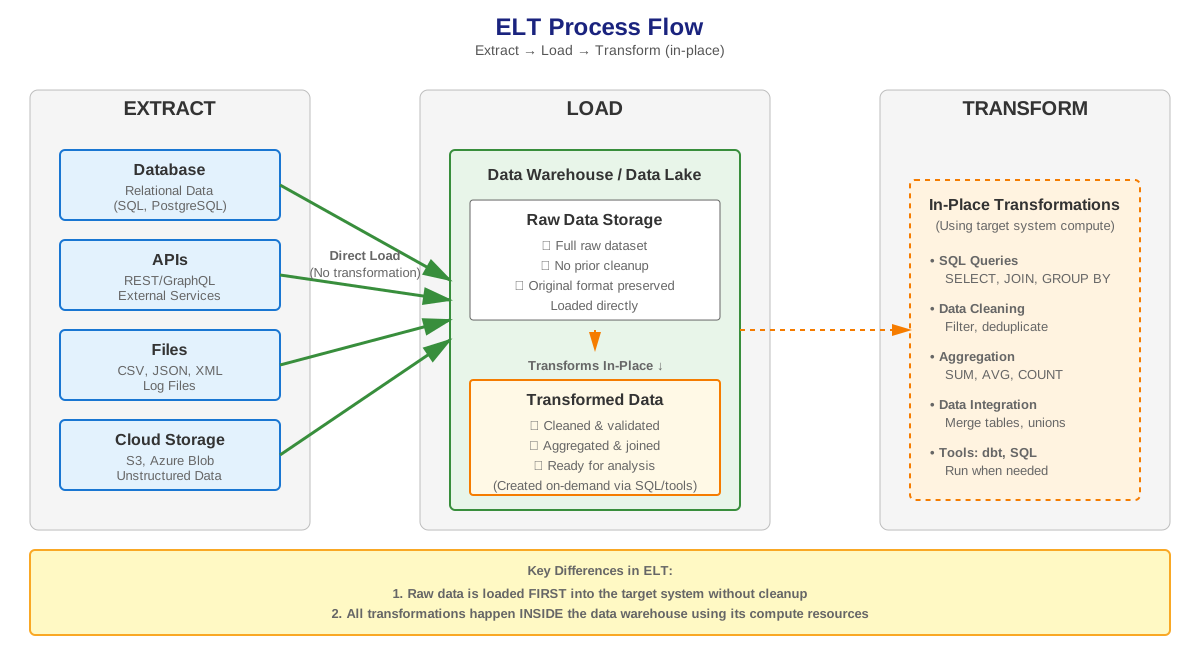
The ELT approach emerged with the rise of cloud computing and big data technologies. Modern cloud data warehouses like Snowflake, Amazon Redshift, Google BigQuery, and Azure Synapse provide virtually unlimited storage and distributed computing power, making it feasible to store raw data and transform it on-demand.
A real-world example of ELT is loading streaming data into a cloud data lake: you can ingest raw event logs or sensor readings immediately, then use SQL or transformation tools within the warehouse to process and analyze that data for specific business needs.
Because ELT loads raw data first, it enables better data governance through post-load controls. Sensitive information can be transformed or masked within the warehouse using SQL policies, views, or access controls, rather than being removed upfront.
How ELT works: The ELT process can be broken into three key steps:
- Extract: Data is collected from one or more source systems (which might include databases, files, applications, or streaming sources). Unlike ETL, ELT can handle diverse data formats without requiring upfront standardization.
- Load: The raw, untransformed data is loaded directly into the target system – typically a cloud data warehouse or data lake – where it can be stored in its original form. This step is fast and scalable, leveraging the target's storage capabilities.
- Transform: Data transformation occurs within the target system using its compute resources. Here it is cleaned, filtered, joined, and structured as needed for analysis. Transformations might include renaming columns, converting data types, applying business rules, or aggregating records, often using SQL queries or tools like dbt.
ELT pipelines are commonly implemented using cloud-native tools and platforms. Modern data integration services like Fivetran, Stitch, or Airbyte focus on the extract and load phases, while transformation tools like dbt handle the "T" within the warehouse environment.
The key characteristic of ELT is that the transformation happens inside the target system – you use a schema-on-read approach where you can define the data structure and interpretation when accessing it, rather than upfront. This provides greater flexibility since raw data remains available for different analytical needs.
ELT is a relatively newer approach compared to ETL, gaining prominence with cloud adoption. While it offers powerful scalability benefits, it requires that your target platform has sufficient compute power to handle transformations at scale.
In summary, ELT is ideal when you need flexibility and speed for large-scale or diverse datasets. It works best with cloud data warehouses and when you want to retain raw data for multiple analytical purposes. However, it requires robust data governance since raw (potentially sensitive) data lands in storage first, and the target system must be powerful enough to handle on-demand transformations.
ETL vs ELT: Key Differences
ETL and ELT ultimately achieve the same goal (moving data from source to target), but they differ in when and how data transformation occurs, which leads to several practical differences. The primary difference is the order and location of the transformation step:
- Transformation Timing: In ETL, data is transformed before loading – typically in an external ETL server or staging area – ensuring only processed data enters the warehouse. In ELT, data is loaded in its raw form and transformed after loading, within the data warehouse or lake environment. This means ETL imposes processing upfront, whereas ELT defers processing to later.
- Use of Resources: Because ETL does the heavy work outside the target system, it often requires a separate ETL engine or intermediary storage. ELT leverages the target system’s resources for transformation, using the scalable infrastructure of modern warehouses instead of bespoke ETL servers. In practice, ETL might rely on custom scripts or ETL tools to handle transformations, whereas ELT uses the SQL engines and compute of the data warehouse to do the work.
- Speed and Scalability: ELT can be faster when dealing with large datasets since it loads data immediately and transforms later. By loading data quickly and possibly transforming in parallel, ELT often ingests data more rapidly than ETL, which has to pause to process data before loading. ETL can become slower and harder to scale as data volume grows, because the pre-loading transformation step can be a bottleneck. For example, if you need to ingest terabytes of data daily, an ETL process might struggle or require significant infrastructure to transform that data on the fly, whereas ELT would load it directly and let the warehouse handle transformations at scale.
- Data Retention and Flexibility: One major advantage of ELT is that the raw data is retained in the target system. All source data (even if not immediately needed) is available and can be re-transformed or queried in new ways later. ETL, on the other hand, only loads the transformed output – once data has been filtered or aggregated during ETL, the original raw details might not be accessible in the warehouse. This means ELT provides a richer historical data archive and more flexibility (you can “go back” to the raw data to answer new questions), whereas ETL provides only what was anticipated and modeled upfront.
- Data Types and Target Schemas: Traditional ETL usually works best for structured data that fits into predefined schemas. Because it uses a schema-on-write approach, ETL requires defining how the data should look before loading. ELT is more adept at handling semi-structured or unstructured data because you can load anything into a data lake or schema-flexible platform and decide on structure later. If you need to integrate diverse data types (text, images, JSON, etc.), ELT (especially with a data lake or schema-flexible warehouse) offers a more straightforward path. In short, ETL typically results in structured outputs, whereas ELT allows storing data in raw form (which could be structured, semi-structured, or unstructured) in the repository.
- Data Quality & Compliance: ETL’s approach of transforming first can be beneficial for data governance. Data cleansing and validation are done before the data is loaded, meaning the warehouse only contains curated data. This is ideal for complying with strict regulations or integrating data into systems that require a certain format. For instance, ETL can ensure that no sensitive personal data reaches the warehouse unmasked, as those transformations (masking, encryption, removal) can be applied in the pipeline. In ELT, since raw data (potentially including sensitive fields) is loaded directly, organizations must enforce compliance within the warehouse – e.g., by restricting access to raw tables or by transforming sensitive data soon after loading. ELT doesn’t inherently prevent bad or sensitive data from landing in storage, so it requires trust in the security of the target platform and proper data governance measures.
- Tooling & Expertise: ETL has been the standard for decades, so many mature tools and skills exist for it. Teams might already have ETL software and experienced developers for writing transformation jobs. ELT is a newer pattern (rising in prominence with cloud data warehouses), and while it simplifies some aspects (fewer moving parts in the pipeline), it shifts the transformation logic into the warehouse layer. This often relies on newer tools (e.g., cloud-native integration services and transformation frameworks like dbt) and approaches that some teams are still ramping up on. That said, the ecosystem for ELT is rapidly growing. Many modern data integration vendors actually promote an “ELT” style: they replicate raw data into the warehouse, then allow you to transform it there. The learning curve might be different (more SQL-based transformation, less Python/Java ETL coding), and documentation for ELT approaches is catching up as best practices evolve.
In essence, the choice of ETL vs ELT has implications for how you design your data architecture. ETL results in a more tightly controlled, model-up-front pipeline, which is great for well-understood, smaller-scale, or sensitive datasets. ELT offers agility and scalability, letting you load now and decide later, which is great for big data and fast-moving analytics.
Many organizations actually find that both approaches have their place. For example, you might use ETL for a legacy database migration where the schema is known and needs to be preserved exactly, but use ELT for new cloud data initiatives where flexibility and speed are paramount.
We’ll compare the two approaches side-by-side next, and then discuss how to decide which to use.
Side-by-Side Comparison of ETL vs ELT
The table below summarizes the key differences between ETL and ELT across various dimensions:
| Aspect | ETL (Extract, Transform, Load) | ELT (Extract, Load, Transform) |
|---|---|---|
| Transformation timing | Transforms data before loading into the target. Data is processed in a separate staging area or ETL server first. | Transforms data after loading. Raw data is loaded into the target system, and then transformed in-place using the target’s computing engine. |
| Performance & scale | Can be slower for very large data volumes, since all data must be processed before loading. Best suited for batch processing of moderate-sized datasets or when real-time speed isn’t critical. | Optimized for large-scale data loads – raw data is loaded quickly without delay, and transformation can occur in parallel. Especially efficient in cloud environments, enabling handling of high-volume or real-time data more easily. |
| Data retention | Only transformed data is stored in the target system. Once loaded, you have the curated dataset, but not the original raw data (meaning you cannot re-query dropped or filtered details later). | All extracted data (raw) is stored in the target system, creating a complete archive. This means you can re-query and re-transform the raw data anytime, providing more flexibility and historical depth for analysis. |
| Data types & lakes | Typically handles structured data that fits a predefined schema. Not inherently compatible with data lake storage of unmodeled data – ETL usually loads into relational warehouses, not raw file lakes. | Easily ingests any data (structured, semi-structured, unstructured) into a warehouse or data lake. Designed to work with data lakes and schema-on-read, so it excels at storing raw data of diverse types and applying structure as needed. |
| Compliance & quality | Data can be cleaned, validated, and anonymized before it enters the warehouse, aiding compliance (e.g. remove or mask PII in the transform stage). The warehouse contains only approved, processed data. | Raw data (possibly including sensitive fields) lands in the warehouse immediately, so strong governance is needed. Compliance rules must be applied within the warehouse (e.g., via post-load transform or access controls) since data isn’t pre-filtered. |
| Maturity & tools | A well-established approach with many traditional ETL tools and experienced practitioners available. Processes and protocols have been refined over decades. Often relies on external ETL software or scripts for transformation. | A newer approach that leverages modern cloud platforms. Tooling is evolving – it often uses cloud-based pipelines to load data and in-warehouse transformation frameworks (like SQL scripts or dbt). While gaining popularity, teams may face a learning curve adopting ELT-oriented tools and best practices. |
Table: Comparison of ETL vs ELT.
Which is Better: ETL or ELT?
When deciding between ETL and ELT, it’s less about one being “better” in absolute terms and more about which is better suited for your specific needs. In fact, many organizations use a mix of both approaches. Here are some guidelines on when each approach is advantageous:
- ETL is preferable when you need to transform data before loading it into the target system.
- If your use case demands strict data cleaning, complex transformations, or compliance checks upfront (for example, scrubbing sensitive information or conforming to a legacy schema), ETL is the way to go.
- ETL is also a good choice for highly structured environments with fixed reporting requirements and for working with systems that might not handle raw data well.
- In scenarios where data volume is manageable and data quality is paramount – such as loading financial data into a regulated banking data warehouse – the deterministic nature of ETL is beneficial.
- ELT is preferable when you want to load data first and transform later, especially if you're dealing with large or rapidly changing datasets.
- ELT shines in modern cloud data warehouses where storage and compute are scalable, and it's ideal for high-volume, raw data pipelines.
- If you anticipate the need to reuse the raw data for different purposes or you have unstructured data (like logs, JSON, images) that you want to store before deciding how to process it, ELT provides that flexibility.
- ELT is often the better choice for real-time analytics, big data environments, or when empowering analysts to iterate on transformations within the data warehouse (since all the data is readily accessible).
In short, neither ETL nor ELT is universally "better" – it depends on the context. Consider factors like data volume, variety, latency requirements, existing infrastructure, and regulatory constraints.
For instance, a small enterprise with an established data warehouse and strict data governance might stick mostly to ETL, whereas a tech startup ingesting huge clickstream datasets might favor ELT to load everything into a cloud lake and worry about modeling later.
Often, the best solution is complementary use: use ETL for what it's best at (pre-processing critical data, ensuring compliance on sensitive fields, handling legacy integrations) and use ELT for what it's best at (rapidly loading big data and enabling flexible, on-demand analysis).
Conclusion
Both ETL and ELT are fundamental techniques for building data pipelines, each with its own strengths. ETL performs upfront transformation, yielding structured, quality-checked data ready for use at the cost of extra processing time and reduced flexibility. ELT loads data immediately and defers modeling until later, providing greater scalability and agility in handling raw data, but requiring trust in downstream processing and governance. The right approach depends on your project’s priorities: if you need predefined structure and control (and have moderate data volumes), ETL may serve you better; if you need speed, scalability, and flexibility to explore large datasets, ELT is often the choice.
The key is to align the method with the use case. By understanding the differences between ETL and ELT, data teams (from beginners to mid-level professionals) can choose the right tool for the job – or even leverage both in tandem – to build efficient, trustworthy data pipelines.
Both ETL and ELT exist to feed a downstream system built for analysis rather than transactions. For the difference between that system and the operational database it pulls from, see our guide to OLAP vs OLTP.
Frequently Asked Questions (FAQs)
What is ETL?
ETL stands for Extract, Transform, Load. It is a data integration process in which data is first extracted from source systems, then transformed (cleaned and formatted) in a separate environment, and finally loaded into a target database or data warehouse. In ETL, the transformation happens before the data is stored in the target, ensuring the loaded data conforms to the target’s schema and quality requirements.
What is ELT?
ELT stands for Extract, Load, Transform. In this approach, data is extracted from sources and loaded as-is (raw) into the target data storage, and the transformation step is performed afterwards within that target system. In other words, ELT loads all the data first (often into a cloud data warehouse or data lake) and then uses the warehouse’s computing power to transform and model the data as needed.
Which is better, ETL or ELT?
Neither approach is inherently 'better' in all cases – it depends on your needs. ETL is better when you need to pre-process and clean data before loading – for example, in scenarios with strict data governance or legacy systems that require formatted data. ELT is better when you have large volumes of data or want more flexibility – for instance, loading big datasets into a cloud warehouse and transforming them on-demand for fast, iterative analysis. Often, a combination is used, applying ETL where upfront transformation is crucial and ELT where rapid loading and scalability are paramount.
What is the difference between ETL and ELT?
The core difference is the order of operations in the data pipeline. In ETL, data is transformed before loading into the target system, whereas in ELT, data is loaded in its raw form and then transformed after it's in the target system. This leads to differences in speed, flexibility, and use cases: ETL does early transformation (good for enforcing schemas and quality before storage), while ELT defers transformation (good for handling large raw data and doing multiple transformations within the storage system).