
Upload CSV files and turn them into dashboards
CSV exports are easy to create, but hard to analyze in a consistent way. Upload a file to Daymark to get answers as charts and tables, then save them to a dashboard you can share with your team.
CSV files are not built for reporting
Manual cleanup
You spend time renaming columns, fixing formats, and correcting types.
Hard to see changes
Trends and outliers can be missed when you work row by row.
Too many versions
New exports create new files and the numbers stop matching.
How Daymark works with CSV files
Go from file upload to dashboard in minutes
Skip the repeated sorting and filtering. Upload your CSV, ask a question in plain English, and save the result to a dashboard for ongoing reporting.
Upload your CSV
Upload a file in minutes with read-only access.

Ask a question
Use plain English to explore the data and get a clear visual answer.
Build a dashboard
Save charts and tables to a dashboard your team can use and share.
An AI workspace for trustworthy metrics
Ask questions in plain English, use data from multiple sources, and save answers as dashboards your team can share. No SQL required.
Ask questions and get clear answers
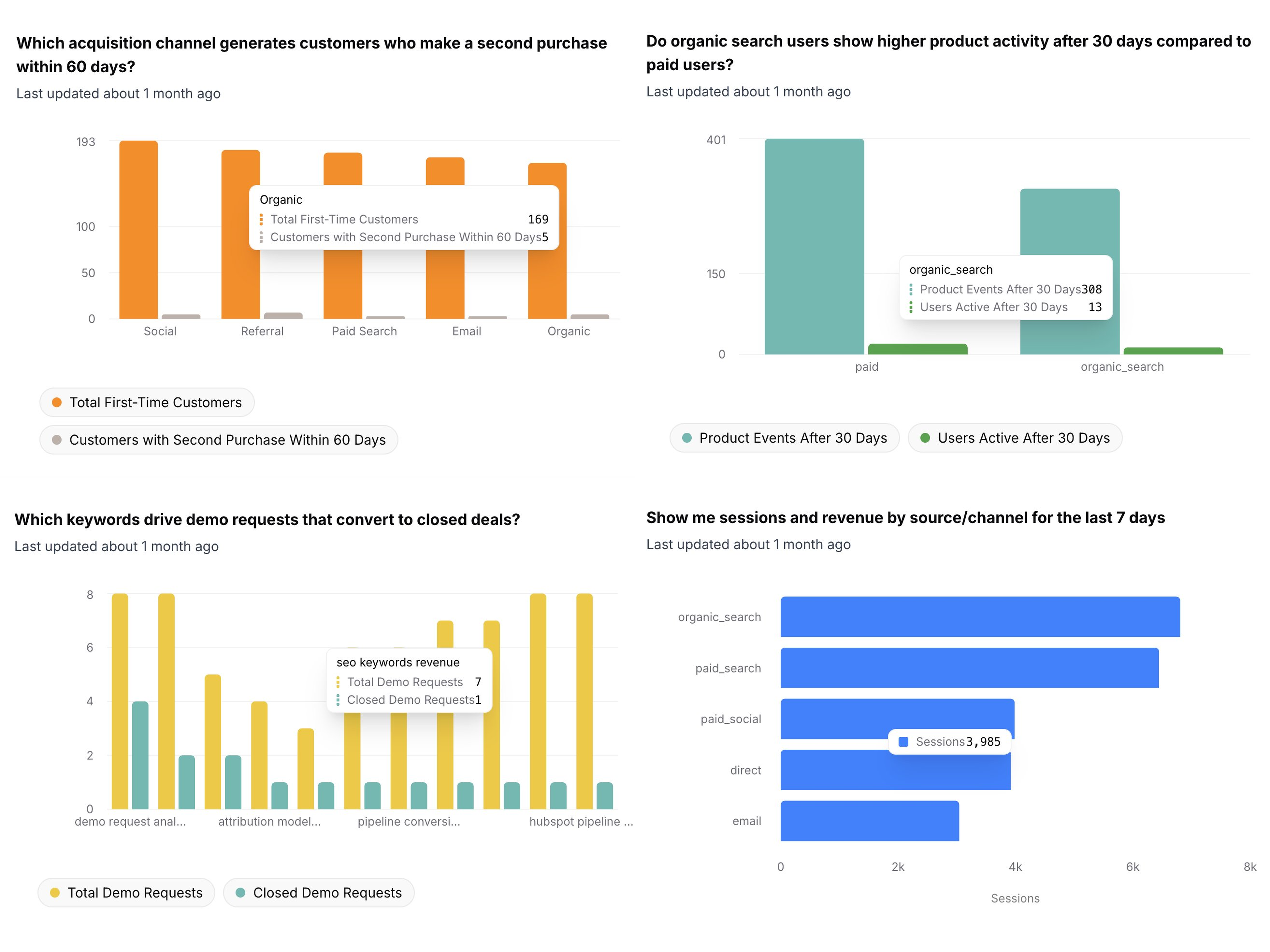
Ask a question and Daymark returns a chart, table, or summary that answers it. Save the result when it is useful.
Use multiple data sources in one place
Bring key metrics from tools like HubSpot, Ads, Analytics, Sheets, and Postgres into one workspace.
 HubSpot
 Google Ads
 Google Analytics
Dashboards your team can share
Save answers to dashboards so your team can review the same metrics. Share dashboards for weekly updates, planning, and reviews.
Your data stays yours
Daymark is built for teams that handle sensitive business data. Read-only access, minimum permissions, and AI that never trains on your data.
Access
Read-only access with least privilege
Daymark uses the minimum scopes required for every integration and never writes to your production systems. All connectors are read-only by design.
- Read-only connectors
- No production writes
- Scoped database access
AI safeguards
Built for safe AI analysis
Our AI agents work only with schema metadata and limited query results to generate insights. Your underlying data is never used to train models.
- No training on your data
- AI agents cannot modify your systems
Connect CSV file in Daymark
Start exploring your data with read-only access in minutes.